How to Handle a Trout Safely During Catch and Release
A released fish is not automatically a saved fish. Plenty of trout swim out of a net looking fine and do not survive the week, and the difference almost always comes down to what happened in the sixty seconds between the hookset and the release.
None of it is complicated. It comes down to a few practical limits: how long the fight runs, how long the fish spends out of water, how you hold it, and how warm the river is that day. Those limits are what this guide covers.
TLDR
- Keep the fish in the water. Air exposure is the single easiest thing to control and the one most anglers get wrong.
- Ten seconds out of water is the target, thirty seconds is the ceiling, and big fish tire faster than small ones.
- Pinch your barbs. Unhooking gets faster, and you lose surprisingly few fish for it.
- Carry a large rubber mesh net. Knotted nylon strips slime and splits fins.
- Wet your hands every time, cradle under the belly, and never hold a trout vertically by the jaw.
- Cut the tippet on a deeply hooked fish instead of digging for the hook.
- Carry a thermometer. Trout stress starts well before the 68 degrees you usually hear quoted.
Why Careful Handling Matters
Catch and release only does its job when the fish swims off healthy enough to feed, hold a lie, and spawn the following spring. A trout that drifts into slack water and dies quietly an hour later has not been released in any meaningful sense. The point of the practice is a living fish, not a returned one.
That matters more here than in a lot of places. The trout in these rivers are wild and self sustaining, not replaced by a hatchery truck each spring. Guided boats make up a real share of the pressure on this water, so how carefully those fish are handled adds up over a season. Every fish that goes back in good shape stays part of the population.
What Happens to a Stressed Trout
A hooked trout is sprinting. It burns through oxygen faster than it can replace it, and lactic acid builds in the muscle the same way it does in yours at the end of a hard run. The longer the fight, the deeper that oxygen debt goes, and clearing it can take a fish hours of sitting in soft water where it is vulnerable.
There is a second layer of damage that is easier to cause and harder to see. Trout carry a slime coat that seals the skin against fungus and infection, and a dry hand, a shirt, or a dry net bag wipes it away in a single contact. The fish looks perfect when it swims off. The infection that follows shows up days later, well out of sight, which is exactly why careful handling feels like it is not doing anything.
Gear That Protects the Fish
Most handling problems are solved before you ever get on the water. Three small gear decisions do more for release survival than any amount of care once a fish is already thrashing in the net.
Barbless Hooks and Faster Release
Flatten your barbs with a pair of pliers before you tie anything on. A barbless hook backs out along the path it went in, which roughly halves unhooking time and measurably lowers mortality, mostly by cutting the seconds a fish spends being handled.
The objection is always the same, that you will lose fish. In practice you lose very few, and almost all of those come from slack line rather than the missing barb. Keep steady tension and the difference over a day is small enough to be hard to notice.
Choosing the Right Landing Net
Net material matters more than net size, though a bag that is too small forces you to fold a fish to fit it. Ranked from best to worst for the fish:
- Large rubber or silicone mesh. Holds almost no water against the fish, does not strip slime, and hooks do not tangle in it, which gets you unhooking faster.
- Knotless soft nylon or micromesh. Workable, gentler than knotted mesh, but it still abrades and hooks catch in it.
- Knotted nylon. The worst option. The knots scrape slime off in lines and split fin rays, and it is the net most likely to leave visible damage.
Whatever you carry, keep the bag wet. A dry net does the same thing to a slime coat that a dry hand does.
Forceps and Wet Hands
Hang a pair of forceps on a zinger where you can reach them without looking. Fumbling through a pack while a fish waits in the net costs more time than the unhooking itself, and time is the currency here.
Wet both hands before every single touch, including the second reach when you shift your grip. Then think about what else the fish might contact. Dry shirts, gravel bars, sun heated boat decks, and knees all strip slime, and a fish that flips out of your hands onto a dry surface has taken more damage than the entire fight caused.
Fight and Land Fish Efficiently
A long fight exhausts a trout more than anything else you do to it, which makes landing fish quickly the highest leverage habit in this whole article. The romantic idea of a patient twenty minute battle with a big cutthroat is, from the fish's side, twenty minutes of oxygen debt it may not clear.
Fish tippet strong enough to actually pressure the fish you are targeting. Light tippet feels sporting and often just extends the fight past what the trout can absorb. Apply steady side pressure low to the water rather than lifting the rod straight up, which turns the fish and tires it far faster than pulling against its back.
Then commit to the net earlier than feels comfortable. A fish landed while it still has something left recovers far better than one played to a standstill, and it is a great deal easier to control in the net.
The Ten Second Air Rule
If you take one number from this article, take this one. Aim for ten seconds or less out of the water, and treat thirty seconds as a hard ceiling you do not cross. Research on trout handled after a hard fight shows survival dropping sharply as air exposure climbs toward that half minute mark, and the fish that struggle most are the ones that fought hardest.
Size changes the math. A large trout loses equilibrium far faster than a small one, because it has more body to support and a bigger oxygen debt to clear. The best fish of your season is exactly the one that can least afford a long photo.
The practical fix is preparation. Have the camera out, on, and framed before the fish leaves the water. Decide who is shooting and where they are standing while the trout is still resting in the net. Almost every long air exposure comes from someone digging for a phone, not from anyone deciding to keep a fish up.
How to Hold a Trout
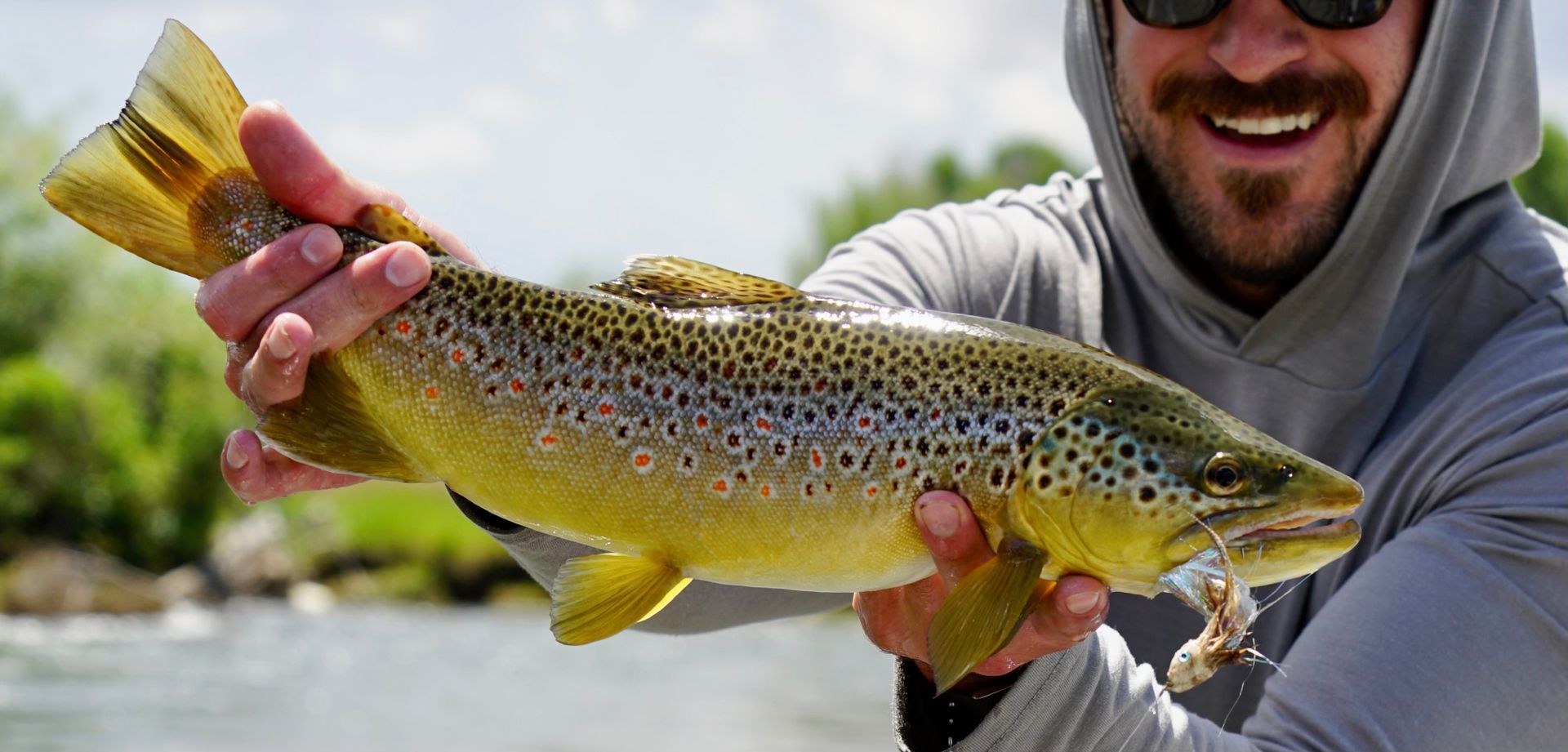
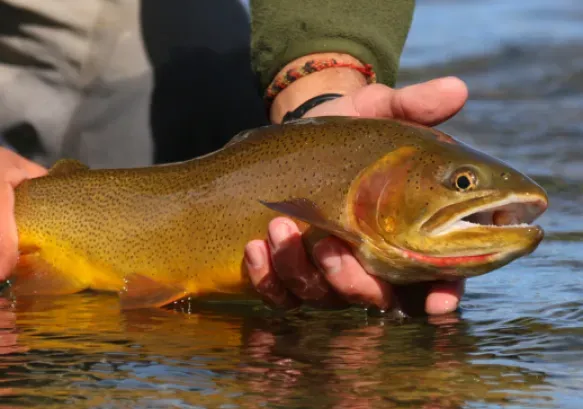
There is one grip worth learning. One wet hand cradles under the belly, just behind the pectoral fins, supporting the weight. The other closes loosely around the wrist of the tail, the narrow section just ahead of the tail fin, steadying the fish without gripping hard. The trout should rest in your hands rather than be held by them.
Three things to avoid, all of them common:
- Squeezing the body. A trout has no rib cage protecting its organs, and a hard grip around the middle can cause internal damage that never shows on the outside.
- Touching the gills. Gill filaments are delicate and bleed easily, and a bleeding fish has poor odds. Keep fingers well clear, and never lift a fish by hooking a hand under the gill plate.
- Holding a fish vertically by the jaw. A trout's body is built to be supported by water at every point. Hanging it by the jaw puts its whole weight on the spine and internal organs.
If the fish starts thrashing, lower it back into the net or the water rather than tightening your grip. Let it settle and start again.
Removing the Hook Cleanly
Unhook the fish in the water, with the net bag submerged and the trout still swimming inside it. There is no reason to lift a fish to take a hook out, and doing the job underwater means the clock on air exposure has not even started.
Take hold of the hook with forceps and back it out along the path it entered, reversing the angle rather than pulling straight against it. With a barbless hook this is usually one movement. Keep your other hand steadying the fish gently rather than gripping it, and work without hurrying, because a calm fish in water has time you do not need to rush.
A deeply hooked fish is a different decision. If the hook is in the throat or gills and you cannot see a clean path out, cut the tippet as close to the hook as you can reach and release the fish with the hook in place. Trout survive that far more often than they survive someone digging for a hook, and hooks left in place corrode and work loose over time.
Taking Photos Without the Harm
You can photograph a good fish without hurting it, and the good news is that the safest photos are usually the best looking ones. Keep the fish low, directly over the water or the net, so that any slip drops it back where it belongs rather than onto gravel or a boat deck.
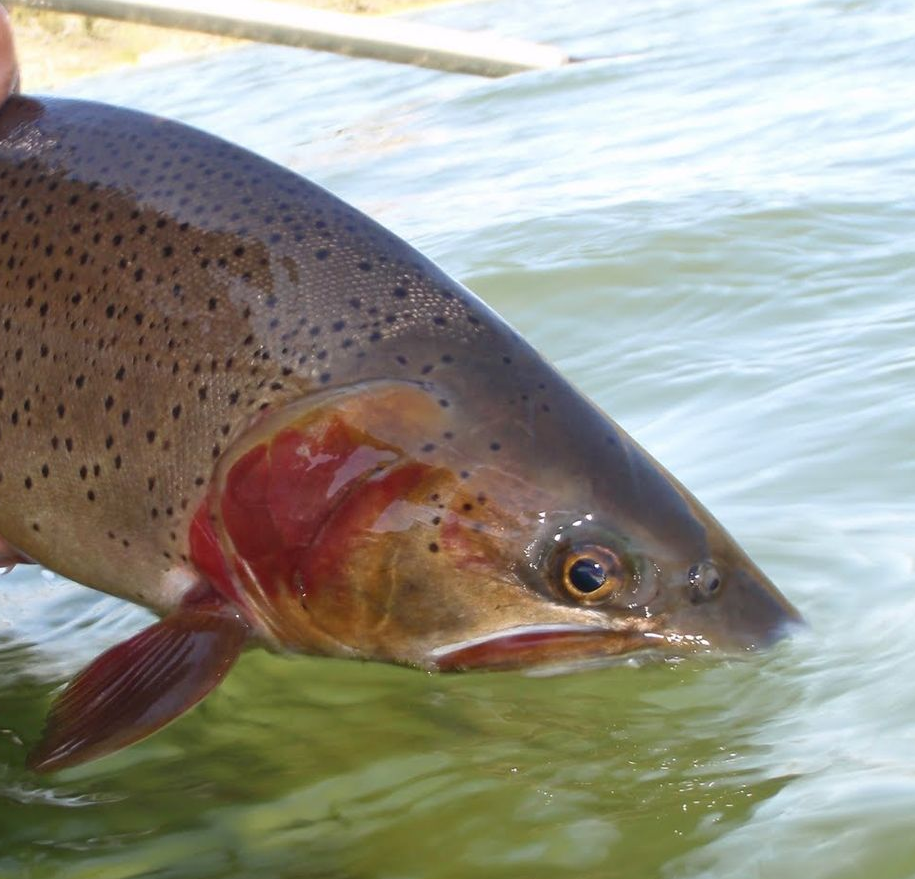
The strongest shots are often taken with the fish still in the net or half submerged, water running off its back, the river visible around it. A wet trout photographs better than a dry one, because the color holds and the light catches the flank. Shoot one or two frames, then put the fish back. If nobody got the shot, that is a fine outcome. Repeated lifts for a better angle are the version of this that costs fish.
Releasing a Trout Properly
Hold the fish loosely in gentle current, facing upstream so that water runs over its gills the right way. Then read it. A trout that is holding itself upright and starting to push against your hand is ready, and the right move is simply to open your hands and let it go. It does not need help.
Skip the back and forth motion you often see, where a fish is pushed forward and pulled backward through the water. Current research favors prompt release over vigorous revival, and dragging a trout backward forces water over the gills in the wrong direction, which does not help it breathe. Steady water flowing forward is all it needs.
Genuinely exhausted fish are the exception. If a trout rolls or cannot stay upright, keep supporting it, upright and facing into soft current, out of the main flow, for as long as it takes. Some take a couple of minutes. Stay with it until it swims off under its own power rather than letting go and hoping.
When Water Is Too Warm
This is the part of catch and release that gets glossed over most often, so it is worth being straight about it. Warm water holds less dissolved oxygen, which means a trout fighting in it starts the exchange already short. Every other precaution in this article matters more as the temperature climbs, and at some point none of them is enough.
The number usually quoted is 68 degrees, and it is too high to be useful as a stopping point. Stress and delayed mortality begin well before that, from around 61 degrees for cutthroat, rainbow, and brook trout. Treating 68 as the line means fishing through a long stretch of water that is already costing fish.
The practical answer is a stream thermometer, which costs very little and sits naturally alongside the rest of the gear to pack for fishing in midsummer. Check the water rather than guessing from the air temperature, which can be twenty degrees off what the river is actually doing.
Then fish accordingly. Start at first light when the river is at its coldest, plan to be off the water by early afternoon in a warm spell, and be willing to stop when the temperature climbs. Higher elevation water and stretches fed by cold tributaries hold up better through a hot week.
Fish Responsibly with Jackson Hole Anglers
Good handling is one of those skills that reads as obvious on the page and looks different in practice. The grip, the timing of the net, the decision to cut a tippet instead of working at a hook, all of it is easiest to pick up by watching someone do it a few dozen times. Guides who know these rivers net, unhook, photograph, and release fish all day, every day of the season, and the habits show.
That is the quiet argument for a guided day. You fish better water and read it faster, and the fish you catch go back in better shape than they would on a self taught first season. Both halves of that come with guided fly fishing trips on the Snake and the surrounding rivers, where every trip is catch and release for exactly the reasons covered above.
However you fish, the sixty seconds after the net are the ones that count. Keep them short, keep the fish wet, and the trout swims off to be caught again. If you are weighing up a stretch of water or want to know how the rivers are running before a trip, you can talk to our fishing guides about what conditions are doing that week.
Recent Posts